De Beer: from paradise to lost promise
Han Brezet
March 2026
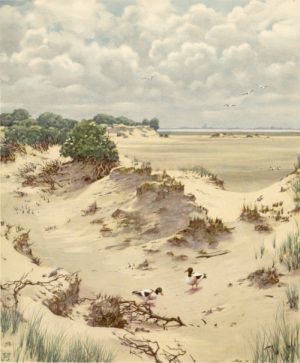
Historical view of De Beer.
Case 1: De Beer before 1963
My personal memories of De Beer as a child in the 1950s are still vivid. It felt like a little paradise within cycling distance of Rotterdam and Hoek van Holland. Fishing in the channel full of sole and plaice, picking blackberries by the bucketful, terns landing in large colonies, and the experience of true freedom when my father and I swam to the temporary sandbank of the Maasvlakte and could walk around for hours.
But De Beer was more than a childlike voyage of discovery. It was also an area of exceptional ecological value and an early milestone in Dutch nature conservation history. The island-like landscape emerged after the construction of the Nieuwe Waterweg in 1872 and developed into a rare transitional area of dunes, mudflats, creeks, salt marshes, and beach plains shaped by the tides.
From the beginning, De Beer became a breeding and resting place of international importance. It hosted spectacular colonies of Great Terns, Common Terns, Little Terns, and gulls, while migratory birds used it as a vital stopover. The vegetation ranged from wet salt marshes to dry dunes, and the waters were rich in fish and also attracted seals.
In the 1920s and 1930s, conservationists and biologists such as Jac. P. Thijsse and Eli Heimans wrote about the area. In 1933, it gained protected status under Natuurmonumenten and became one of the first large bird reserves in the Netherlands. In that sense, De Beer symbolised a new awareness that nature had a value and a right to exist of its own.
Later, Ed Buijsman would describe De Beer as a lost paradise. That term resonates deeply here: a landscape of childhood wonder, ecological richness, and proximity to the city, yet ultimately sacrificed to the economic logic of port expansion. In 1963, De Beer disappeared under the sand and asphalt of Europoort.
Case 2: The lost promise, 1963 to today
What followed was not only the loss of a unique nature reserve, but the beginning of a pattern. Every further expansion of the port, from Maasvlakte 1 to Maasvlakte 2 and now discussions around Maasvlakte 3, came with promises of nature compensation. Each time, those promises turned out to be far less real than presented.
Maasvlakte 1 marked the definitive end of De Beer. Maasvlakte 2 repeated the same logic, now with promises of marine compensation and protected underwater areas. In practice, sand extraction and other disturbance continued, ecological recovery did not follow, and even the original condition of the seabed became hard to reconstruct.
The contrast with earlier experience is stark. Where De Beer once offered fish, birds, and a living sea, the shoreline of Maasvlakte 2 now feels empty and industrial. Container cranes, coal handling, chemical infrastructure, and discussions of further energy expansion dominate the horizon. The ecological vitality of the area has been profoundly reduced.
The broader lesson is that the language of compensation has too often masked irreversible loss. Lost ecosystems cannot simply be recreated elsewhere. In that sense, the story of De Beer is not only about one vanished landscape, but also about the repeated failure to match sustainability promises with ecological reality.